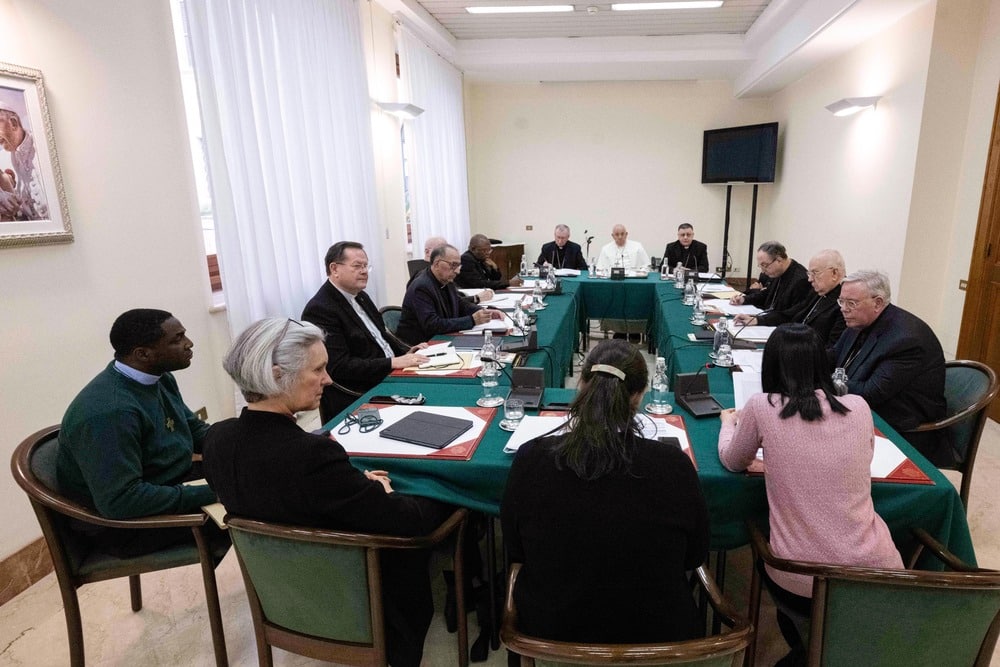
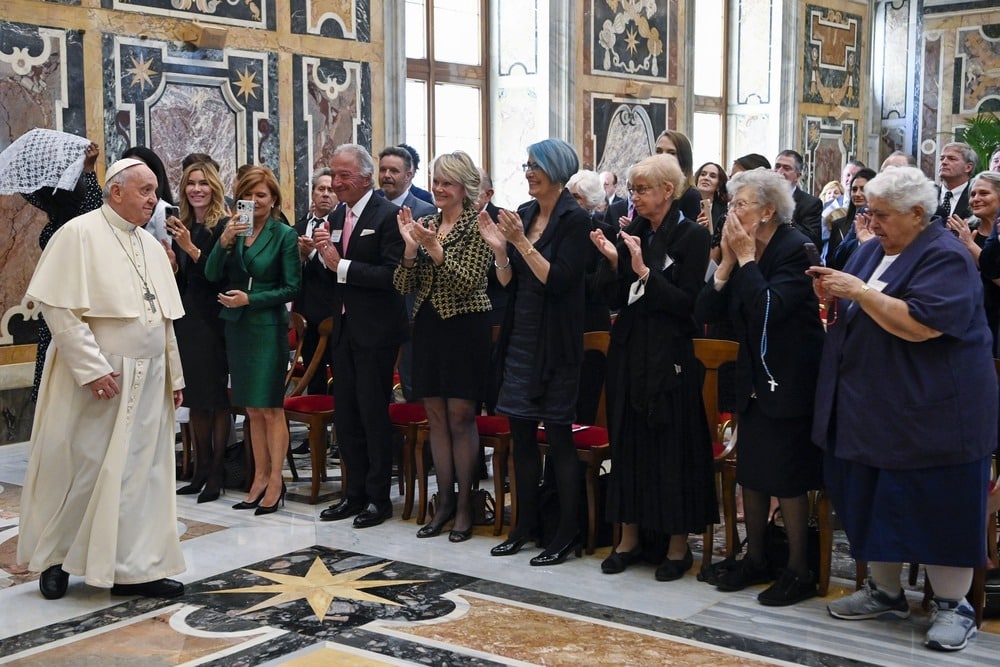
Pope Francis and his international Council of Cardinals continued their discussions about the role of women in the church, listening to women experts, including a professor who spoke about how culture impacts women’s roles and status.
The pope and the nine-member Council of Cardinals invited women, including an Anglican bishop, to make presentations at their meetings in December and in February as well.
The council met April 15-16 in the Domus Sanctae Marthae, the pope’s residence, the Vatican press office said.
On the first day, Sister Regina da Costa Pedro, a member of the Missionary Sisters of the Immaculate and director of the Pontifical Mission Societies of Brazil, shared « concrete stories and the thoughts of some Brazilian women, » the press office said.
Stella Morra, a professor of theology at Rome’s Pontifical Gregorian University, « examined the role cultures have in the recognition of the role of women in different parts of the world, » the press office said.
A priest and two women made presentations at the council’s December meeting and published their papers in Italian in a book with a foreword by Francis, « Smaschilizzare La Chiesa? » (« De-masculinize the Church?).
During the preparation for the synod on synodality and during its first assembly in October, the pope wrote in the foreword, « We realized that we have not listened enough to the voice of women in the church and that the church still has a lot to learn. »
« It is necessary to listen to each other to ‘de-masculinize’ the church because the church is a communion of men and women who share the same faith and the same baptismal dignity, » he wrote.
At the February meeting, the pope and cardinals heard from: Bishop Jo Bailey Wells, deputy secretary-general of the Anglican Communion; Salesian Sister Linda Pocher, a professor of Christology and Mariology at Rome’s Pontifical Faculty of Educational Sciences « Auxilium »; and Giuliva Di Berardino, a consecrated virgin and liturgist from the Diocese of Verona, Italy.
Bailey Wells said she was invited to « describe the Anglican journey in regard to the ordination of women, both in the Church of England and across the (Anglican) Communion. »
At the April meeting, the Vatican said, the second day began with a report about the ongoing Synod of Bishops on synodality by Cardinal Mario Grech, secretary-general of the Synod of Bishops, and Msgr. Piero Coda, secretary general of the International Theological Commission.
The meeting concluded « with reports from each cardinal on the social, political and ecclesial situation in his home region, » the press office said.
« Throughout the session there were references — and on several occasions prayer — dedicated to the scenarios of war and conflict being experienced in so many places around the world, particularly in the Middle East and in Ukraine, » the statement said.
« The cardinals — and with them the pope — expressed concern about what is taking place and their hope for an increase in efforts to identify paths of negotiation and peace, » it said.
The council will meet again in June.
The members of the council are: Cardinals Pietro Parolin, Vatican secretary of state; Seán P. O’Malley of Boston; Sérgio da Rocha of São Salvador da Bahia, Brazil; Oswald Gracias of Mumbai, India; Fernando Vérgez Alzaga, president of the commission governing Vatican City State; Jean-Claude Hollerich of Luxembourg; Gérald C. Lacroix of Québec; Juan José Omella Omella of Barcelona; and Fridolin Ambongo Besungu of Kinshasa, Congo. Bishop Marco Mellino serves as the council’s secretary.
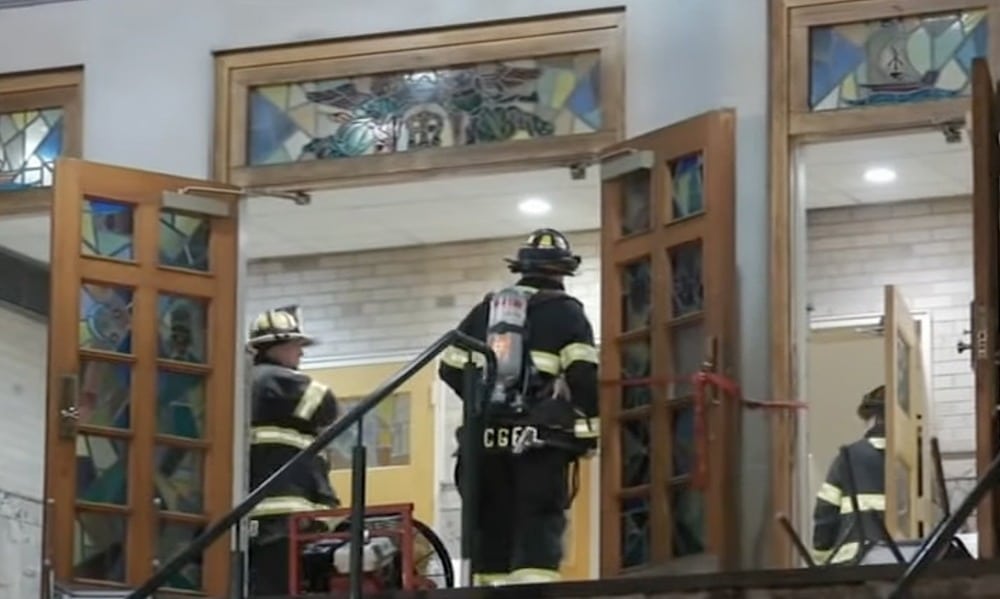
After an early morning fire April 4 reportedly set by a resident damaged the sanctuary of Our Lady of the Lake Church in Verona, the church could reopen its doors for Mass the weekend of April 20-21, said Father Peter G. Wehrle, pastor.
On April 4, Elliot Bennett, 42, allegedly broke into the church using a crowbar and set fire to about 10 pews, statues of Mary and Joseph, and the altar, according to police reports. Bennett turned himself into the Verona police station just hours after the incident admitting to the crime, and faces nine charges including burglary, arson, weapons and bias intimidation, according to the Essex County Prosecutor’s Office.
Fire alarms alerted the fire department, which quickly extinguished the fire. In a Facebook announcement to the community on April 4, Wehrle, said the fire did not damage the structure of the church, which was built in 1964 to replace a smaller church and accommodate a then-burgeoning parish.
« Fortunately, the structure appears to be sound, but the church is heavily damaged, » he wrote. « However, we are grateful that no one was injured. … Faith teaches us that we are all created in the image and likeness of God and that we must ask him to help guide everyone into the way of his peace. »
Wehrle said a restoration company was brought in to clean up the soot. The pipe organ and pews were scheduled to be assessed by professionals. The statues, the kneelers in front of them and altar linens were destroyed.
« Unfortunately, the church is heavily damaged, and the parish community is heartbroken, » the Archdiocese of Newark said in a statement. « However, we have faith that we will get through this difficult time and request the community to keep those affected in their prayers. »
Rabbi Robert Tobin of B’nai Shalom in West Orange comforted Father Wehrle as he assessed the damage from the fire. Pastor Anthony Giordano of the Calvary Lutheran Church, which is located around the block from Our Lady of the Lake, also offered the parish community his church.
« Sanctuaries are supposed to be a place of peace, » he said, adding that the fire was « devastating to someone like myself who treasures all houses of worship. »
Just hours before the fire, Muslims, Jews and Christians joined together at an Iftar dinner held in town. Wehrle said faith leaders discussed the shared values of their faiths including the importance of fasting.
« We have received an outpouring of support from various houses of worship and individuals and by the grace of God, we will work together to help instill a sense of peace in our community, » Wehrle said.
« Unfortunately, this isn’t the first time Elliot has caused damage at our church, » Wehrle told Jersey Catholic, Newark’s archdiocesan news outlet. Bennett was arrested last year after he admitted to defacing a statue of Jesus outside the church, police said. In 2018, he was arrested after he smashed statues of Jesus, St. John and the Blessed Mary, saying people should not « worship false idols made from stone, » according to police.
Although the items around the church sustained damage, the fire did not damage the faith of the 2,700 parishioners, many of whom attended last weekend’s Masses relocated to the neighboring school auditorium.
During Mass on April 7, Wehrle asked for prayers for Elliot and his family while calling for a reconsideration of how we approach mental illness.
« We need to be helping him and praying for him and his family, » Father Wehrle said in his homily.
The church had just celebrated a joyous Easter season. Newark Cardinal Joseph W. Tobin celebrated Palm Sunday at Our Lady of the Lake on Palm Sunday, March 24. Father Wehrle said over 2,000 of the faithful attended Easter Masses. The church is also celebrating its centennial this year.
The U.S. Conference of Catholic Bishops has documented over 300 acts of vandalism, arson, and other destruction at parishes and other Catholic sites in the United States since 2020. These include arson and statues getting beheaded, cut, smashed, and painted. Gravestones have also been defaced with swastikas and anti-Catholic language, and American flags next to the graves have been burned.
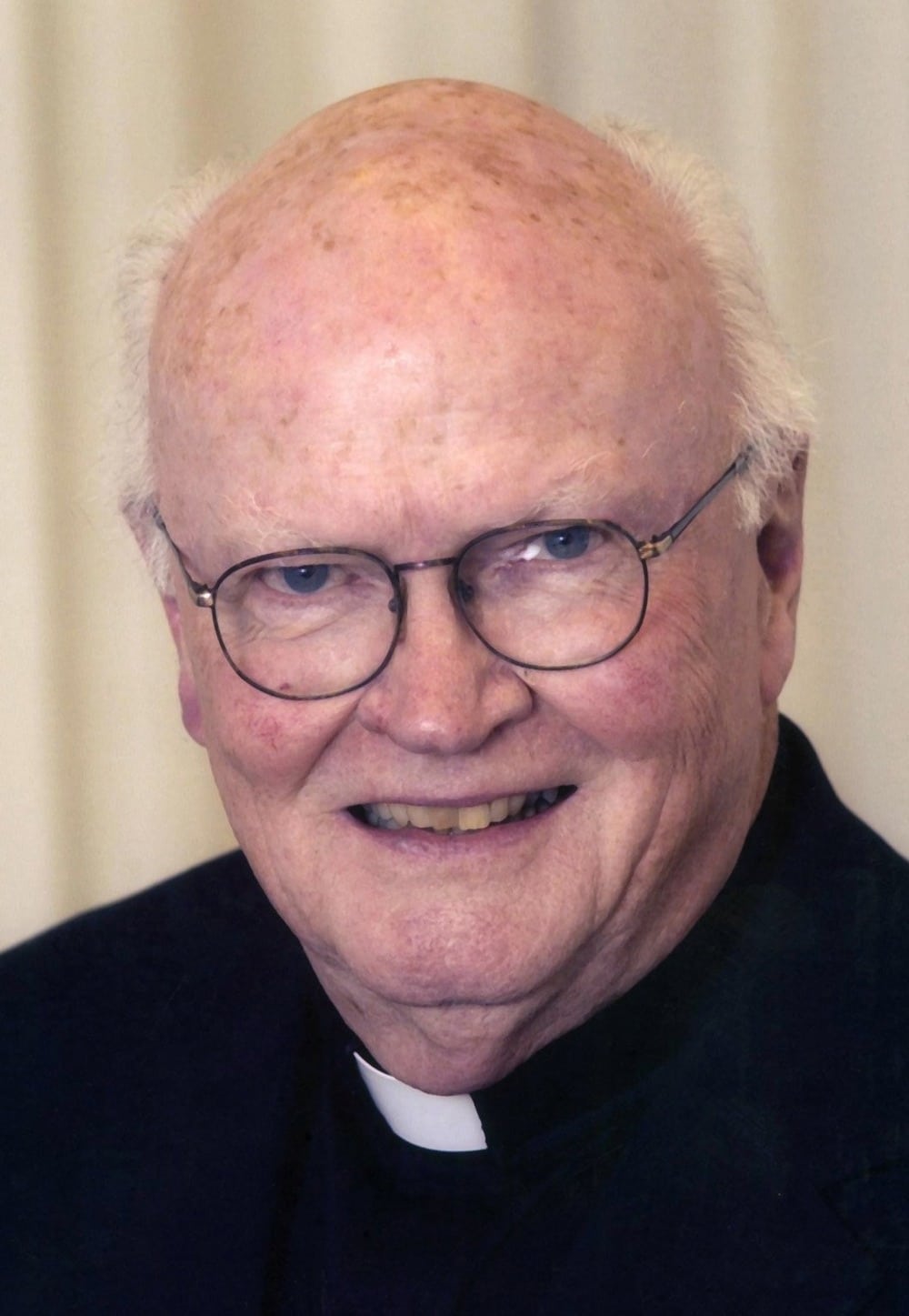
Jesuit Father William J. Byron, known for his leadership of Jesuit institutions of higher learning and his many years of lecturing, teaching and writing on the relationship between business practices and Catholic spirituality, died at Manresa Hall, the health center of the Jesuit community at St. Joseph’s University in Philadelphia April 9. He was 96.
Byron was a former president of the University of Scranton in Pennsylvania, 1975-1982, and The Catholic University of America in Washington, 1982-1992. He spent a year as acting president of Loyola University New Orleans, 2003-2004, and served as president of his high school alma mater, St. Joseph’s Preparatory School in Philadelphia, 2006-2008.
His other leadership roles for the Society of Jesus included rector of the Jesuit community at Georgetown University in Washington, 1994-2000.
A funeral Mass for Byron will be celebrated April 20 at St. Matthias Church in Bala Cynwyd, Pennsylvania. A viewing will take place in the church at 10 a.m. followed by the Mass at 11 a.m.
Jesuit Father Joseph Marina, current president of the University of Scranton, said Byron « will be greatly missed. »
« As I walked into his room at the Jesuit infirmary, Father Byron was sitting up in his chair, alert but struggling, » Marina said in an April 9 message to the university community. « He managed to ask if I was the president at Scranton now. When I nodded yes, he said, ‘Take good care of it.' »
« Father Byron is among those who have given greatly to build a solid foundation for our mission and success at Scranton on which we continue to flourish to this very day, » Marina added.
During his tenure at Scranton, among other things, Byron launched a multimillion-dollar capital campaign for the school. Also, a new undergraduate college, the School of Management, was created, along with new programs including nursing and physical therapy.
After serving as Scranton’s 21st president, Byron became the first member of a religious order to be named president of The Catholic University of America in Washington. He was the school’s 12th president.
« Father Byron was an exceptional leader in Catholic higher education, » Catholic University’s current president, Peter Kilpatrick, said in an April 9 message to the university community. « Father Byron was known for being an inspiring intellectual who had an ability to connect powerfully with people and with ideas. Alumni remember him fondly for his close relationships with students, and for his leadership. »
He tripled the university’s endowment while fundraising the first $50 million that went toward the construction of more undergraduate housing, the Columbus School of Law building and the Pryzbyla Center, a venue at the heart of the campus for concerts, live stage performances, public forums and lectures.
After helming the nation’s only papally chartered university, he became a professor at Jesuit-run Georgetown University in Washington. At the same time he was rector of the Jesuit community at Georgetown and director of the university’s Center of Advanced Study of Ethics. He then was pastor for three years at nearby Holy Trinity Church, 2000 to 2003. Next, he was acting president at Loyola University New Orleans, followed by two years as a professor of economics at Loyola Maryland in Baltimore, 2004 to 2006, the year he became president of St. Joseph’s Prep.
Before retiring from academia in 2009, Byron taught a graduate course in the Haub School of Business at St. Joseph’s University. In his later years, he continued writing and publishing. In 2019, he moved to Manresa Hall at St. Joseph’s University, « where he enjoyed visits with students and never missed an opportunity to sing the St. Joseph’s prep fight song, » said a news release from the Jesuits’ USA East Province, based in New York.
Whether he was serving « as an administrator, professor or parish priest, » Byron « always made a concerted effort to build up community with his Jesuit brothers in unassuming ways and to promote the apostolates of the Society of Jesus with a discerning, generous, and upbeat spirit, » the province said in a statement.
Byron was the author of more than 20 books and dozens of articles. In 2001, he became a regular columnist for Catholic News Service. The biweekly column, titled « Looking Around, » covered current issues. He wrote his last column, which ran April 18, 2017, as a « fond farewell » to « those who have enjoyed my writing over the years. »
« Writing a column is like putting a note in a bottle and tossing it into the river so it can float down and across the bay and out into the ocean. You never know whose shore it will wash up on, » he said, noting that the latest of his many books, « Growing Old Gratefully, » would be published later that year by Paulist Press.
« Old age is a gift, » he said. « I can attest to that, so why not welcome it with gratitude? »
A Pittsburgh native who grew up in Philadelphia, William James Byron was born May 25, 1927. His father, a physician, died when Bill was 1, and his mother moved with him and his older brother, Harold, to Philadelphia’s East Germantown neighborhood. Both boys graduated from St. Joseph’s Preparatory School.
After Bill turned 18, he registered for the draft and subsequently spent 17 weeks in the Army’s basic training camp near Macon, Georgia, but was never deployed overseas. After the war, he went to Germany as part of the Army of Occupation, where he joined the 508th Parachute Infantry Regiment of the 82nd Airborne Division. He finished his tour of duty there in November 1946 and returned to Philadelphia.
He joined the Jesuit order in 1950 and was ordained a priest in 1961 by Archbishop Francis P. Keough of Baltimore. He held degrees in philosophy and economics from St. Louis University, two theology degrees from Woodstock College and a doctorate in economics from the University of Maryland. Over his lifetime, he received 30 honorary degrees.
Byron’s career as an administrator began in October 1969 as an associate professor and rector of the Jesuit community at the now-closed Woodstock College, the Jesuit seminary in New York. It was relocated to New York from Baltimore in 1969 and closed in 1974.
He served on a number of boards for Catholic entities including the Association of Jesuit Colleges and Universities and the Association of Catholic Colleges and Universities, which in 1999 bestowed on him its Theodore M. Hesburgh Award for his contributions over the years to the advancement of Catholic higher education. He was a founding director and chairman of Bread for the World, a Christian lobby group that fights hunger.
(Third Sunday of Easter-Year B; This homily was given on April 13 & 14, 2024 at Saint Augustine Church in Providence, Rhode Island; See Acts 3:13-19, 1 John 2:1-5 and Luke 24:35-48)
As a brown-skinned son of immigrants, Kappadakunnel once assumed his « place in society was that of an outsider, » but he also admits there was a time when he looked down on people who crossed the Mexican border without documentation for not immigrating legally, like his parents. It was only when he spent time on the Mexican side of Nogales with a Catholic initiative called El Comedor that Kappadakunnel experienced a conversion of heart and mind. There, he encountered people — God’s people — who were « desperate, trying to escape treacherous circumstances that threatened their lives, their safety, and their families, » and he was filled with compassion and understanding for their plight.
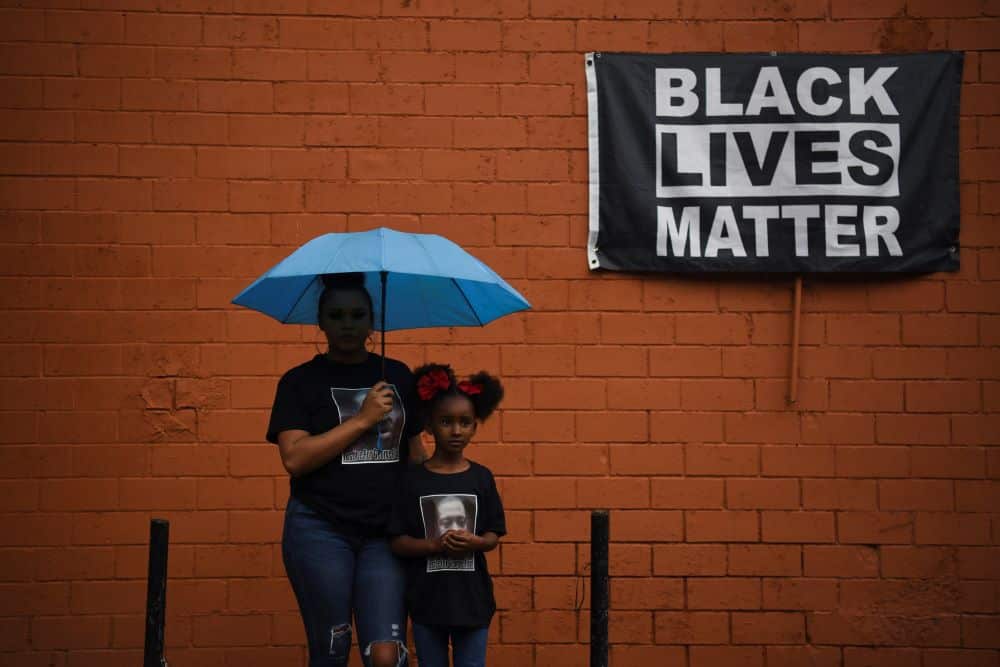
Likewise, it wasn’t until the death of George Floyd in 2020 that Kappadakunnel felt called to speak out against anti-Black racism. For most of his life he assumed the role of the « model minority, » which meant he would « fall in line with American society » and align with « white American beliefs and values. » For him, « recognizing and challenging racism in both society and the Church » were considered taboo.
Kappadakunnel describes his former belief that social justice was the responsibility of nonprofit organizations, while his vocation was prayer and leading people to Jesus. Then during the pandemic, after watching a video that showed a police officer callously murder Floyd, Kappadakunnel realized that he was not living in a post-racial society. He knew he had to speak out against racial injustice. Written in a prophetic voice, The Catholic Church and the Struggle for Racial Justice is Kappadakunnel’s forceful and compelling plea for all Catholics still asleep to wake up.
Kappadakunnel also gets personal. He relays how the Eurocentric teachings of St. Francis Xavier, a Spanish Jesuit missionary who arrived in Goa, India, in 1540, led him to internalize harmful, negative views of fellow Indian people. Though Xavier is still revered by many Indians today, in the 16th century he wrote about Goan people in ways that can only be described as racist.
For example, in The Letters and Instructions of Francis Xavier, Xavier wrote that Indians made for poor vocations due to their lack of commitment — both to the order and to celibacy. Xavier also made more explicitly colorist condemnations of Goans’ skin color writing: « [Indians] being black themselves, consider their own color the best, they believe that their gods are black … the great majority of their idols are as black as black can be … and seem to be as dirty as they are ugly and horrible to look at. »
Kappadakunnel humbly repents of his past view of himself as superior to Indian people since he was American born. His honesty may resonate with Catholic readers who hold their own internal bias and spur them to an examination of conscience.
Aside from his personal story of conversion and spiritual awakening, Kappadakunnel’s book is a clarion call urging all Catholics to work toward racial and social justice. It convincingly makes the case that the Catholic Church is not only universal and therefore multicultural, but that her diversity is one of the reasons the church was able to spread to all corners of the world and last until today. Racism and discrimination, therefore, are clear contradictions to Catholicism and God’s kingdom.
After making the case for why racism is incongruous with Catholicism, Kappadakunnel critically examines the U.S. Catholic Conference of Bishops’ writings and actions on the topic of racism. He delves into the world of prominent, wealthy conservative donors that are heavily influencing the direction of the Catholic faith. When he discusses the Napa Institute’s annual conference at Timothy Busch’s Meritage Resort and Spa in Napa Valley — an event with registration that costs nearly $2,000 and nightly rates over $500 — Kappadakunnel states, « Based on the criteria of this conference, Jesus would not have been welcomed, since his message encompassed inviting ‘the poor, the crippled, the lame and the blind’ to the banquet (Luke 14:13), none of whom would be able to attend … »
My biggest critique of the book involves the repeated references to working with the Black Lives Matter Global Network (BLMGN), which has in many respects fallen from grace and lost much public support. Black Lives Matter Grassroots organizations, a collective of community groups across the country, sued BLMGN, claiming had fundraised off the work of the chapters, but mismanaged the funds and had shut local chapters out of decision making and profits. The lawsuit was dismissed, However, while Black Lives Matter as a global network has diminished in power and efficacy, the truth that Black Lives Matter and the convictions behind the statement still remain true and relevant today.
Overall, I commend Kappadakunnel for his book and believe it would be beneficial for Catholics to read.
I will be 80 years old in June. As a young child in the Methodist Church, I was certain I was called to ordained ministry. At Duke University, I majored in religious studies and then served as pastoral assistant and director of religious education in a small church in upstate New York. Then, in the summer of 1967, I went to Tucson to study creative movement expression education at the Tucson Creative Dance Center.
Now, where would I go to church? There was time and opportunity to explore.
I visited the Methodists, the Presbyterians and the Lutherans, but no particular place beckoned. I had already ruled out the Catholic church — but then the maintenance man at the dance center convinced me to give it a try. « Go to a 6 a.m. Mass. You’ll still have time to go somewhere else after that. »
I snuck into a back pew at 5:45 and knelt down, unprepared for what was to follow. The priest appeared, looking like he had just rolled out of bed, kissed the altar, mumbled, « The Lord be with you, » and then snorted and wiped his nose across the sleeve of his alb!
What immediately went through my mind was, « These people are not here for this man, They must be here for … God! »
Laugh if you will, but I knew at that moment I would become a Catholic. What about my call to ordination? No worries. It was 1968. Vatican II. Change was in the air. All I had to do was be patient. Ordination of women was just around the corner.
A few years later, I was a full-fledged Catholic. I worked at a parish school for more than 15 years, first as a teacher and then as a liturgist. When it came time for a change, I took a year off to write and live under private religious vows, supplementing my savings with part time jobs.
Over the years, I earned a master’s in pastoral ministry from the University of San Francisco, along with certificates in spiritual direction and therapeutic harp work.
I then went to work for 15 years as a certified music practitioner, playing my harp at the bedside of patients at a hospice inpatient unit. It was a « holy ground » experience. The unit felt like a church, and the patients like beloved parishioners.
The hospice was looking to increase its number of chaplains, so I enrolled in the ordination program at the New Seminary for Interfaith Studies, a two-year, low residency program in New York City. There were three women in the accelerated program — all three of us Catholic! All denied ordination by our own church, nevertheless grateful for this path to ordination as interfaith ministers.
After retirement from hospice, and until COVID-19 shut everything down, I volunteered weekly as a chaplain and bedside harpist at a Tucson hospital.
Now I write for the Keeping the Faith section of the Sunday edition of the Arizona Daily Star, drawing on the many years of work for the Catholic church and the broader Christian community.
I have no complaints. But I will forever ask, « Why? » Why couldn’t I be ordained by my own church for service in hospice, hospital, a retreat center, the military, a women’s prison, a battered women’s shelter, a parish church?
I do not see myself as a victim of an intentionally discriminatory church, but as a keeper of the vision in an institution that has yet to deal scientifically, scripturally, theologically, morally or justly with women.
Some women tell me that because women’s ordination may not happen in their lifetime, they cannot stay in the church. But as for me, I know this is not a matter of « my » lifetime, nor is it about « me. » It is about the call and the vision that will be realized in its time. And I have a responsibility to hold and give voice to that vision while I am able despite my accumulating years.
I cannot leave a church that feeds me liturgically and sacramentally, one that nourishes my soul with ancient wisdom and profound practices of prayer, contemplation and spiritual pilgrimage.
I will continue to voice the vision because if I do not, I will not be the person God has created me to be. And because when a vision remains unvoiced, and a call goes unanswered, the church is poorer for it.
Today’s « growing culture of indifference and individualism » must be countered with prayer and adoration, which inspires solidarity with those in need, Pope Francis said.
Charitable efforts guided and inspired by the Catholic faith « must be continually nourished by participation in the life of the church, the reception of the sacraments, and time spent quietly before the Lord in prayer and adoration, » the pope told more than 60 members of The Papal Foundation and their families April 12.
The U.S. foundation describes itself as the only charitable organization in the United States dedicated to fulfilling the pope’s requests for the needs of the Catholic Church. Donors to the foundation, known as Stewards of St. Peter, make annual pilgrimages to Rome and have an opportunity to meet the pope.
Francis reminded the group that the pilgrimage this year is taking place during the Year of Prayer in preparation for the Holy Year 2025, and he encouraged them to « not forget to adore the Lord » in silent adoration. « We have neglected this form of prayer and we need to take it up again: adoring the Lord in silence. »
« Through our perseverance in prayer, we gradually become ‘a single heart and soul’ with both Jesus and others, which then translates into solidarity and the sharing of our daily bread, » he said, referencing a passage from the Acts of the Apostles.
The pope noted that although the donors may not personally meet the beneficiaries of their generosity, « the programs of The Papal Foundation foster a spiritual and fraternal bond with people from many different cultures, languages and regions who receive assistance. »
The foundation announced in a statement April 12 that it will dedicate $14.74 million to grants, scholarships and humanitarian aid in 2024.
Close to $10 million will be distributed to grant recipients identified by the Vatican, supporting 118 projects in more than 60 countries, the foundation said, including projects to provide for basic needs such as access to clean water; renovating schools, churches, convents and seminaries; and building health care facilities. The foundation also allocated $4 million to its Mission Fund to provide humanitarian aid and disaster relief, and it will provide $819,000 in scholarships to enable more than 100 priests, women religious and seminarians to study in Rome.
Cardinal Seán P. O’Malley of Boston, chairman of the foundation’s board of trustees, said in the statement that the generosity of The Papal Foundation’s donors prioritizes the needs of the poor and vulnerable « in a society where the divide between rich and poor continues to grow. »
In their meeting, Francis thanked the group for helping the successors of St. Peter « to build up many local churches and care for large numbers of the less fortunate. »
Cardinals O’Malley, Blase J. Cupich of Chicago and Wilton D. Gregory of Washington attended the meeting as trustees of the foundation, as well as Archbishops Samuel J. Aquila of Denver and Gregory M. Aymond of New Orleans and Bishop James Checchio of Metuchen, New Jersey.
According to the foundation’s website, it has awarded more than $200 million in grants and scholarships selected by the popes since its founding in 1988.
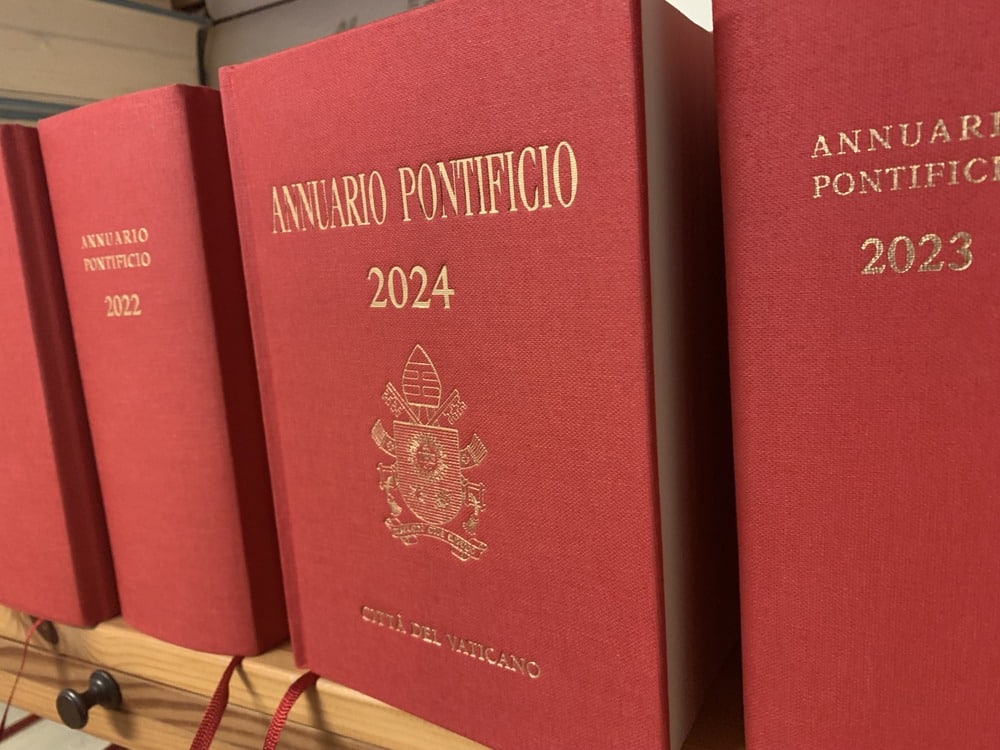
The 2024 edition of the Vatican yearbook has inserted « Patriarch of the West » as one of the historical titles of the pope.
In 2006, Pope Benedict XVI dropped « Patriarch of the West » from his official titles listed in the Annuario Pontificio, the Vatican yearbook. Vatican officials at the time said the title was removed because it was theologically imprecise and historically obsolete.
In 2019, Pope Francis had all the remaining titles, except for « Bishop of Rome, » moved to another page, and in the 2020 edition of the Annuario they were listed as « historic titles. »
The titles labeled historic were: « Vicar of Jesus Christ. Successor of the Prince of the Apostles. Supreme Pontiff of the Universal Church. Primate of Italy. Archbishop and Metropolitan of the Province of Rome. Sovereign of Vatican City State. Servant of the Servants of God. »
The 2024 Annuario, which went on sale in early April, inserted « Patriarch of the West » after « Supreme Pontiff of the Universal Church. »
As of April 11, the Vatican press office said it had no explanation for the change.
Last year Cardinal Raniero Cantalamessa, preacher of the papal household, told officials of the Roman Curia that he noted « with joy » that only one title is listed under the pope’s name: Bishop of Rome.
« It seems right to me, especially with regard to ‘Vicar of Jesus Christ,' » the cardinal said. « Vicar is one who takes the place of the boss in his absence, but Jesus Christ never made himself absent and will never be absent from his church. »
When Pope Francis had the titles re-labeled, Matteo Bruni, director of the Vatican press office, told Catholic News Service that unlike in 2006 when Pope Benedict XVI had the title « Patriarch of the West » removed from the list, this time « there has been no suppression » of a title.
« The definition of ‘historic’ in relation to the titles attributed to the pope on one of the pages dedicated to him in the Annuario Pontificio of 2020 seems to me to indicate the bond with the history of the papacy, » Bruni said. All of the other titles « are understood to be tied historically to the title of bishop of Rome because at the moment he is designated by the conclave to guide the church of Rome, the one elected acquires the titles tied to this nomination. »
Before Pope Benedict dropped « Patriarch of the West, » the last time the list of titles was changed was with St. Paul VI’s 1969 edition of the Annuario, which added the title « servant of the servants of God » and deleted the phrase « gloriously reigning. »
Pope Francis’ first words to the public after his election March 13, 2013, were: « Brothers and sisters, good evening. You all know that the duty of the conclave was to give a bishop to Rome. It seems that my brother cardinals have gone almost to the ends of the earth to get him … but here we are. »
The pope has said in interviews that he has not considered resigning, but if he ever did, he would be known as the « bishop of Rome emeritus » and not « pope emeritus » as Pope Benedict was.
When Pope Benedict dropped the title « Patriarch of the West, » the then-Pontifical Council for Promoting Christian Unity issued a statement, which said, « The title « Patriarch of the West » was adopted in the year 642 by Pope Theodore. Thereafter it appeared only occasionally and did not have a clear meaning. It flourished in the 16th and 17th centuries in the context of a general increase in the pope’s titles and appeared for the first time in the Annuario Pontificio in 1863.
While patriarchates have always been tied to a specific location and jurisdiction over it, « the term West currently refers to a cultural context not limited only to Western Europe but including North America, Australia and New Zealand, thus differentiating itself from other cultural contexts, » the pontifical council said. « If we wished to give the term West a meaning applicable to ecclesiastical juridical language, it could be understood only in reference to the Latin Church. In this way, the title ‘Patriarch of the West’ would describe the bishop of Rome’s special relationship with the Latin Church and could express the special jurisdiction he has over her. »
Members of the synod of bishops of the Ecumenical Orthodox Patriarchate of Constantinople expressed concern over the decision, however. In a June 2006 statement, the chief secretary of the synod said dropping « Patriarch of the West » while retaining the titles « Vicar of Jesus Christ » and « Supreme Pontiff of the Universal Church » is « perceived as implying a universal jurisdiction of the bishop of Rome over the entire church, which is something the Orthodox have never accepted. »
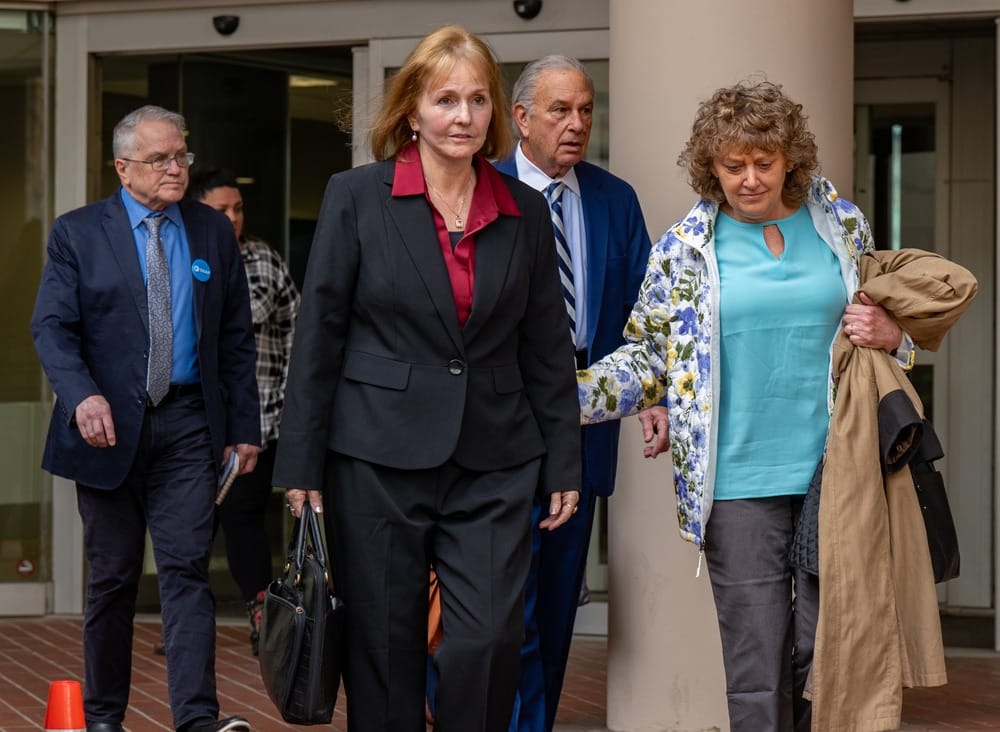
Six victim-survivors of sexual abuse by clergy in the Archdiocese of Baltimore gave statements in court April 8 about the long-term impact of the abuse on their lives as part of the federal bankruptcy reorganization.
The testimonies were off the record and not transcribed. Judge Michelle M. Harner, who is overseeing the Chapter 11 case, noted that the statements are not evidentiary in the case.
Their primary purpose, she said, was to « increase engagement and understanding » and to provide a forum for those affected by the pre-bankruptcy conduct of the archdiocese and its representatives.
« Today is a listening session and an opportunity for individuals to be heard, » Harner said.
Archbishop William E. Lori and Auxiliary Bishop Adam J. Parker attended the hearing, sitting in the front of the courtroom. They both hugged the first survivor who spoke.
Harner thanked each person who made a statement — three women and three men — for their participation in the process. About 50 people attended the hearing at the federal courthouse in Baltimore.
Some of those who spoke to the court specifically addressed the archbishop. In one poignant moment, one of the victim-survivors also turned to address other victim-survivors in court, reminding them that as adults, they can take control of their healing.
Some common themes emerged in the victim-survivors’ statements — further abuse, troubled marriages and divorces, issues of trusting anyone, and other problems that have plagued their lives. Some noted that the chance to bring their experience to the court would be an important part of their healing.
In one touching moment, during one victim-survivor’s statement, the woman who was first to speak reached over the handrail to hold the hand of her husband, sitting just behind her. The session, scheduled for two hours, ended after just an hour. Another such session is scheduled for May 20, which Lori also will attend.
Paul Jan Zdunek, who chairs the Unsecured Creditors Committee, a group of seven people who represent all the victim-survivors in the case, said after the session that he was surprised at how quickly the session went, « despite it didn’t feel that way. I thought everyone was really great with their words and their preparation and the courage that it took to do that in front of everybody. »
He said he appreciated that the judge supported the process and allowed each participant to have the time they needed to tell their story.
« We even heard from them that this was a healing moment and a moment they’ve been waiting for in some cases 50 years, which is extraordinary. I think what struck me today was beyond the moments that happened when they were children, how much it has affected them since, you know, 50 years ago, 60 years of a life gone, » Zdunek told the Catholic Review, Baltimore’s archdiocesan news outlet.
He said he was not surprised to hear that many of those who spoke have issues trusting others, especially because the abuse happened in a church or school by someone who was supposed to minister to them. « Here it is the one place that you’re supposed to be safe and have been told, you know, as a Catholic raised myself, that this is the truth, the light, the way, the place for salvation — and to have that be the place that trust leaves you is devastating, » Zdunek said.
In advance of the hearing, he said the members of the survivors committee — five of whom attended the hearing — purposely wanted to allow others not on the committee to have the first opportunity to speak in court. He said that in this process, the committee already has the ear of the archbishop. « We thought it was important for others to really have the chance to speak. »
He expects the May 20 hearing to be similar. « He wanted to see how this went first, but I’d imagine it’s not going to be too much different than this. »
The deadline to file a claim in the case is May 31.
Teresa F. Lancaster, one of those who spoke in court, addressed reporters after the hearing and noted that she had testified in support of the Child Victims Act passed by the Maryland General Assembly in 2023, which removed the statute of limitations for civil suits for child sexual abuse.
She acknowledged that abuse has happened not just in the church, but also in other schools and organizations.
Asked whether her day in court was a day that she has long been waiting for, Lancaster, who eventually became an attorney so she could help other victims, said, « We wanted our day in court and we were deprived of it. So, I felt somewhat, and I want all the survivors to feel that, hey, your voice has been heard, you’re just as important, and people know what happened now. »
Outside the courthouse after the hearing, Lori said he came as a pastor and priest and was moved by the testimony that he heard.
« My meetings with victim-survivors over the years have taught me the importance of their being able to tell their story, the importance of being heard and listened to, and being believed, and so I came to listen, » he said, adding that he « hopes that by doing this I can contribute in some small way to the healing of these individuals and what they’ve been through. »
He said that after the passage of the Child Victims Act, the archdiocese filed for Chapter 11 reorganization « so that we could, in fact, help as many victim survivors as equitably as we can while at the same time carrying forward the mission of the church, of our parishes, our charities and our schools. »
Asked if he has said he is sorry for the pain experienced by those abused, the archbishop said, « I’ve said it many times, and will say it to the end of my life. But I recognize that no apology of mine undoes what was done. Listening, believing, does a lot more.
« I’ve listened and met with victim survivors for a long, long time and every time I listen, it shakes me — every time. »
In a statement released later in the day, Lori said, « I am deeply grateful to the victim-survivors for their courage today and I am moved by their heart-rending experience.
« To the victim-survivors who long to hear that someone is sorry for the trauma they endured and for its life-altering consequences: I am profoundly sorry. I offer my sincerest apology on behalf of the archdiocese for the terrible harm caused to them by representatives of the church, » he said. « What happened to them never should have occurred. No child should ever, ever suffer such harm. »
He added his thanks to those of Harner, saying, « I ask that the focus today be on the courage and bravery of the women and men who offered their statements and those they represent.
« Their stories and those of the victim-survivors I’ve met with privately for decades, emboldens our response and determination to ensure no child in our care is ever again harmed. I am grateful to the Survivors Committee for initiating the request to offer victim-survivors this opportunity today, which I sincerely pray will further assist them in their journey toward healing. »
The hearing comes a year and three days after the Maryland Office of the Attorney General released an extensive report on clergy sexual abuse of minors in the Archdiocese of Baltimore. Maryland Gov. Wes Moore, a Democrat, signed the Child Victims Act into law April 11, 2023. It went into effect Oct. 1, 2023.
We use cookies to personalise content and ads, to provide social media features and to analyse our traffic. We also share information about your use of our site with our social media, advertising and analytics partners. View more
Cookies settings
Accept
Privacy & Cookie policy
Privacy & Cookies policy
Cookies list
Cookie name
Active
Utilisation
Qui sont les Chevaliers ?
Les Chevaliers de Colomb sont la plus grande organisation de service fraternel familial catholique au monde, avec 1,8 million de membres. Elle offre aux membres et à leurs familles des possibilités de bénévolat au service de l'Église catholique, de leurs communautés, des familles et des jeunes.
Avantages pour les membres
En tant que membre des Chevaliers de Colomb, vous et votre famille bénéficiez de nombreux avantages, notamment 12 numéros gratuits par an du magazine Columbia, le plus grand magazine familial catholique au monde, la possibilité d'adhérer au programme d'assurance-vie de premier ordre des Chevaliers de Colomb, et de nombreux autres avantages familiaux et personnels.
Comment devenir membre
L'adhésion aux Chevaliers de Colomb est ouverte aux hommes catholiques pratiquants en union avec le Saint-Siège, âgés d'au moins 18 ans. Un catholique pratiquant est une personne qui vit selon les commandements de Dieu et les préceptes de l'Église. Les formulaires de demande sont disponibles auprès de tout membre des Chevaliers de Colomb.Si vous souhaitez rejoindre les Chevaliers de Colomb, veuillez contacter notre président des adhésions, Mike Lenzi, au (973) 533-9791 ou envoyez un courriel à contact@kofc3533.org.
4ème Degré
Tout membre du Troisième Degré en règle, un an après l'anniversaire de son Premier Degré, est éligible pour devenir membre du Quatrième Degré. L'objectif principal du Quatrième Degré est d'encourager l'esprit de patriotisme en promouvant une citoyenneté responsable ainsi que l'amour et la loyauté envers les pays respectifs des Chevaliers par le biais d'une adhésion active à des groupes locaux du Quatrième Degré (appelés "assemblées"). Certains membres du Quatrième Degré servent de gardes d'honneur lors de manifestations civiques et religieuses, une activité qui a apporté une reconnaissance mondiale aux Chevaliers de Colomb.Pour contacter les Chevaliers de Colomb du premier district de NJ, veuillez cliquer ici.
Auxiliaires féminines
La fonction principale des Dames auxiliaires est de SOUTENIR les hommes et le conseil. Elles le font principalement en fournissant de l'aide lors des événements, en cuisinant pour les événements et en fournissant une aide financière. Elles aident aussi généralement à mettre en place et à embellir la salle pour les événements.
Écuyers
Sous la direction du frère chrétien Barnabas McDonald (1865-1929), le premier cercle Columbian Squires a été institué en 1925. L'adhésion aux Squires est réservée aux garçons catholiques âgés de 12 à 17 ans. Les activités des Squires sont nombreuses, allant de la spiritualité au service actif pour l'Église et la communauté. Chaque cercle élit des membres officiers de leur propre rang, enseignant les compétences de leadership et de responsabilité.
Membership
Who are the Knights?
The Knights of Columbus is the world’s largest Catholic family fraternal service organization with 1.8 million members. It provides members and their families with volunteer opportunities in service to the Catholic Church, their communities, families and young people.Member BenefitsAs a member of the Knights of Columbus you and your family enjoy many benefits, including 12 free issues annually of the Columbia magazine, the world’s largest Catholic family magazine, eligibility to join the Knights of Columbus top-ranked life insurance program, and many more family and personal benefits.
How to join
Membership in the Knights of Columbus is open to practicing Catholic men in union with the Holy See, who are at least 18 years old. A practicing Catholic is one who lives up to the Commandments of God and the precepts of the Church. Application blanks are available from any member of the Knights of Columbus.If you are interested in joining the Knights of Columbus, please contact our membership chairman, Mike Lenzi, at (973) 533-9791 or send an email to membership@kofc3533.org.
4th Degree
Any Third Degree member in good standing, one year after the anniversary of his First Degree, is eligible for membership in the Fourth Degree. The primary purpose of the Fourth Degree is to foster the spirit of patriotism by promoting responsible citizenship and a love of and loyalty to the Knights’ respective countries through active membership in local Fourth Degree groups (called “assemblies”). Certain members of the Fourth Degree serve as honor guards at civic and religious functions, an activity that has brought worldwide recognition to the Knights of Columbus.To contact the NJ First District Knights of Columbus, please click here.Ladies AuxiliaryThe Ladies Auxiliary’s main function is to SUPPORT the men and the council. They do this primarily by providing help at events, cooking for events and providing monetary help. They also generally do help with setting up and beautifying the hall for events.SquiresUnder the guidance of Christian Brother Barnabas McDonald (1865-1929), the first Columbian Squires circle was instituted in 1925. Membership in the Squires is for Catholic boys between the ages of 12 and 17. Squires’ activities are many, varying from spiritual to active service for the Church and community. Each circle elects officer members from their own rank, teaching skills of leadership and responsibility.